August 10, 2026 · 10 min read
What Should You Check Before Building on Land You Already Own in Northeast Texas?
Own land in Hunt County or Northeast Texas? What to verify about septic, water, electric, drainage, and access before you build. From a Greenville builder.
By Dave McIlrath, Owner at Bravos Builders in Greenville, Texas
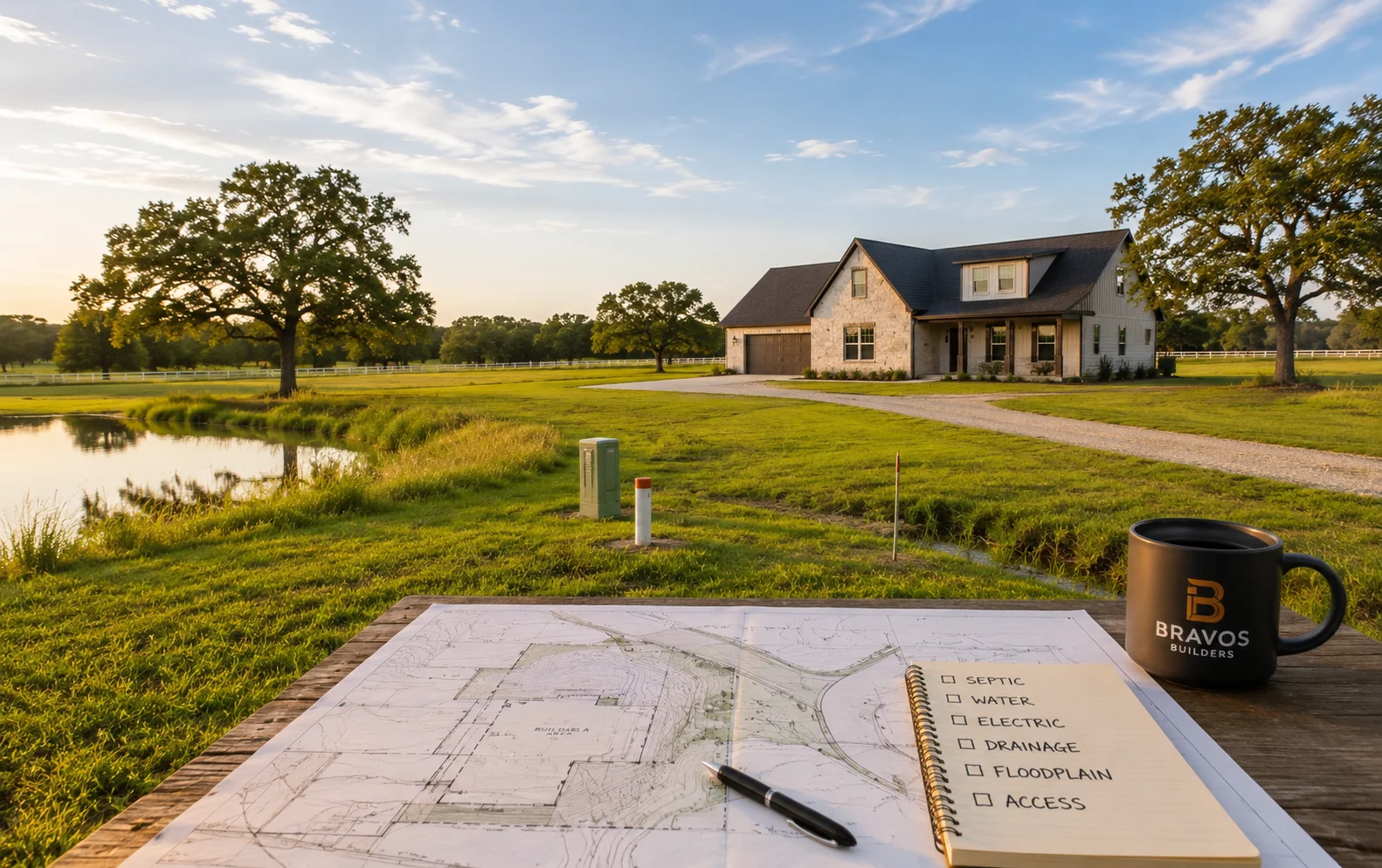
Before building on land you own in Northeast Texas, verify six things: whether the soil will support a septic system, where your water will come from, how far the nearest electric line is, how water drains across the site, whether any part of the build sits in a mapped floodplain, and how you will legally access the property from the road. Those six answers determine your budget and your schedule more than your floor plan does.
This is general guidance for landowners, not an engineering opinion, a permit determination, or a legal opinion about your title or easements. A registered sanitarian or professional engineer evaluates your soil, the county determines your permits, and a title company or attorney answers access and easement questions for your specific parcel.
The thing most landowners get backwards
People pick the house first.
They find a plan they love, sometimes buy it, sometimes hire a designer to draw one, and then bring it to a builder to price. And then they learn that the plan does not fit the buildable area, or that the septic field has to go where the driveway was going to go, or that the pad they wanted is in a drainage path.
The land decides more than the plan does. Every time. On rural property in this part of Texas, the parcel writes the first draft of your budget and your schedule, and the house adapts to it.
So this page walks the six checks in the order we actually walk them.
1. Will your soil support a septic system?
This is the first question on rural land, and it can end a project.
Most homes outside city limits in Hunt County and the surrounding area are on an on site sewage facility. Texas Commission on Environmental Quality rules at 30 TAC 285.3 require a permit and an approved plan to construct, alter, repair, extend, or operate one. In Hunt County that permitting runs through the Hunt County Health Department at 2701 Johnson Street, Greenville, TX 75401, phone 903-408-4140.
Before a system can be designed, someone has to evaluate your soil. That is a site and soil evaluation performed by a registered sanitarian or a professional engineer, and what they find determines what kind of system your parcel can legally support. Blackland Prairie clay is dense and drains slowly, which matters a great deal here, because a conventional drain field depends on soil that will actually accept water.
Three practical consequences.
The system type sets a cost you cannot know from a listing photo. A conventional system and an aerobic system are not the same number.
The system needs physical room, and it needs to be located away from wells and away from your neighbor's well. Setback distances are part of the design, and they consume usable land.
The system is sized for the house you are building. Bedroom count and projected water flow drive the design. Change the house later and you may be back in the permitting process, which is covered in our remodel cost guide.
If you take one thing from this page: get the soil evaluated before you buy plans. It is the cheapest early answer available and it constrains everything downstream.
2. Where is your water coming from?
Two answers, and they behave very differently.
A rural water supply corporation meter. Much of Northeast Texas is served by member owned water supply corporations. If your parcel has a meter or can get one, you pay a tap or membership fee and run a line to the house. The questions to ask are whether a meter is available for your parcel at all, what it costs, how long the wait is, and whether the available line pressure and volume are adequate for a home. Availability is not automatic, and in growing areas there can be a queue.
A drilled well. You are paying for depth, and depth is a local variable. Add a pump, a pressure tank, and often treatment, because water chemistry in this region varies from parcel to parcel. Get well reports from neighboring properties if you can. A licensed water well driller who works your area is worth a conversation before you commit to a budget.
Either way, this is a number you should have before you finalize a build budget, not one you discover in month three.
3. How far is the nearest electric line?
Most of this region is served by Farmers Electric Cooperative, a member owned cooperative headquartered in Greenville, Texas. Farmers EC was organized in the 1930s, energized its first lines on September 14, 1938, and now serves a territory spanning Dallas, Collin, Rockwall, Hunt, Kaufman, Rains, Hopkins, Delta, Franklin, Fannin, Van Zandt, and Wood counties.
Here is the practical part, straight from Farmers EC's own construction guidance: contact a Farmers EC field engineer before a meter pole is purchased or set. The meter loop and pole location has to be somewhere that works for both you and the cooperative. People buy a pole, set it where it seems sensible, and then find out it is wrong.
Two more things worth knowing. Farmers EC also warns that moving or tampering with flagged or marked material used to indicate a line extension can result in extra re-staking charges. And you will want to sort out temporary construction power separately from permanent service, because the build needs power long before the house does.
If your homesite sits well back from existing line, extending service is both a cost and a schedule item, and it belongs in the plan early.
4. How does water move across your land?
Walk it after a hard rain. Seriously. That single hour tells you more than a topographic map.
You are looking for where water collects, where it runs, and where it leaves the property. The pad has to go somewhere that sheds water, the driveway has to cross drainage without damming it, and the septic field cannot sit in a wet area.
Hunt County's engineering standards are explicit that all driveways crossing open drainage ditches must be serviced by culverts. That is not a formality. A culvert that is undersized or set at the wrong elevation causes water to back up onto your property or your neighbor's, and that is a problem that gets expensive after it is built.
On Blackland Prairie clay this matters twice over. The soil holds water at the surface and moves seasonally underneath. Getting drainage right at the site planning stage protects the foundation for the life of the house.
5. Is any part of the build in a floodplain?
Find out before you design anything.
Hunt County requires a floodplain development construction permit prior to any construction in the floodplain. That is a real, separate approval process. And where a parcel sits in or adjacent to a mapped floodplain, Hunt County's development regulations require finished floor elevation to be at least two feet above the base flood elevation.
That requirement can change your entire site plan. It can mean more fill, a different pad location, or an elevated foundation. It can also affect your flood insurance and, through that, your lender.
A parcel can be partially in a flood zone and still be perfectly buildable. The mistake is finding out after the plan is drawn.
6. Can you legally get to it?
Access sounds obvious and it is where deals fall apart.
Confirm your parcel has legal frontage on a public road, or a recorded easement that actually permits the access you need. A handshake with a neighbor is not access.
Confirm which authority controls the approach. If your driveway ties into a county road, the county precinct commissioner's office governs it. If it ties into a state highway, that is TxDOT and a different permit entirely.
Confirm the road can carry construction traffic. Concrete trucks and lumber deliveries are heavy, and some rural approaches and bridges have real limits.
And confirm whether your land sits inside a city's extraterritorial jurisdiction. The ETJ is the area outside a city's limits where that city can still enforce its subdivision rules. Parcels near Greenville, Royse City, Caddo Mills, or Commerce may be subject to city requirements even though they are technically outside the city.
Do I need a building permit to build on my own land in Hunt County?
It depends on whether the parcel is inside a city limit, and Texas is unusual here.
The Texas Legislature abolished the Texas Residential Construction Commission through the sunset process in 2009, which eliminated statewide enforcement of building codes for residential construction. In its place, the Legislature gave counties limited, permissive authority to enforce building codes in unincorporated areas. Permissive means some counties adopted that authority and some did not.
So: inside city limits, you permit through that city's building department. Outside city limits, county authority over residential building is narrower and varies. What does not vary is that septic permitting, floodplain permitting, and driveway access approval still apply regardless of where the house sits.
Do not take a general answer on this from any website, including this one. Call the city building department for your address, or Hunt County for unincorporated property, and get the answer for your specific parcel before you plan around it.
Start here: your first two weeks
- Pull your deed and survey. Confirm acreage, boundaries, easements, and legal road frontage.
- Check the flood zone for the parcel.
- Call the Hunt County Health Department at 903-408-4140 and ask what is required for a new OSSF on your property.
- Call Farmers Electric Cooperative and ask how far service is from your intended homesite.
- Determine your water source. Water supply corporation meter availability, or well feasibility.
- Walk the property after a rain and note where water collects and runs.
- Then talk to a builder. With those six answers, a builder can give you a real range instead of a guess.
Signs a parcel needs a hard second look
- No recorded legal access, only a neighbor's goodwill.
- Standing water across a large portion of the site days after rain.
- Nearest electric line is a long distance from any sensible homesite.
- No water supply corporation meter available and no well data nearby.
- A significant share of the usable area sits in a mapped floodplain.
- The seller cannot say whether the soil has ever been evaluated for septic.
None of these automatically kill a build. All of them change the budget, and several of them change it a lot.
Why talk to a builder before you talk to a designer?
Because a builder can tell you what your land will and will not allow, and a plan drawn before that conversation is a plan that may not survive it.
Bravos Builders builds on land clients already own, which means these six checks are the first conversation rather than a later complication. Dave McIlrath is also a licensed Texas realtor , so questions about the parcel itself and questions about what can be built on it get answered in the same conversation.
We would rather tell you a parcel is going to be expensive to build on before you have spent money on plans than after.
Frequently asked questions
Can I build a house on land I already own in Hunt County?
In most cases yes, though the parcel has to support a legal wastewater system, have an available water source, have electric service reachable, have legal road access, and comply with floodplain rules if any part of the build is in a mapped flood zone. The order that matters is verifying those before selecting a plan, because the land constrains the house rather than the other way around.
Do I need a septic permit before building on rural land in Hunt County?
Yes. Texas rules at 30 TAC 285.3 require a permit and an approved plan to construct an on site sewage facility, and a site and soil evaluation by a registered sanitarian or professional engineer comes first. In Hunt County the permitting authority is the Hunt County Health Department at 2701 Johnson Street in Greenville, phone 903-408-4140.
How do I get electricity to a rural homesite in Northeast Texas?
Most of this region is served by Farmers Electric Cooperative, headquartered in Greenville, Texas and serving Dallas, Collin, Rockwall, Hunt, Kaufman, Rains, Hopkins, Delta, Franklin, Fannin, Van Zandt, and Wood counties. Contact a Farmers EC field engineer before purchasing or setting a meter pole, because the meter loop and pole location must be acceptable to both you and the cooperative. Distance from existing line drives both the cost and the schedule of a service extension.
Do I need a permit to build in a floodplain in Hunt County?
Yes. Hunt County requires a floodplain development construction permit before any construction in the floodplain, and its development regulations require finished floor elevation to be at least two feet above the base flood elevation for lots in or adjacent to the base flood elevation. Determine your flood zone before you design, because the requirement can change your pad location, your fill, and your foundation.
Does my driveway need a culvert?
If it crosses an open drainage ditch, yes. Hunt County engineering standards require all driveways crossing open drainage ditches to be serviced by culverts. Sizing and elevation are engineering questions, not guesses, because an undersized or misplaced culvert backs water onto your property or your neighbor's.
Does Bravos Builders build on land I already own?
Yes. Building on land clients already own is a core part of what Bravos Builders does. Bravos is a custom home builder based in Greenville, Texas, serving Rockwall, Greenville, Royse City, Caddo Mills, Farmersville, Poetry, Bonham, McKinney, Sulphur Springs, Hunt County, and surrounding Northeast Texas communities.
Ready to talk about your build? Schedule a build readiness call with Bravos Builders in Greenville, Texas and let's talk about your land and your home.
Schedule a Build Readiness Call